
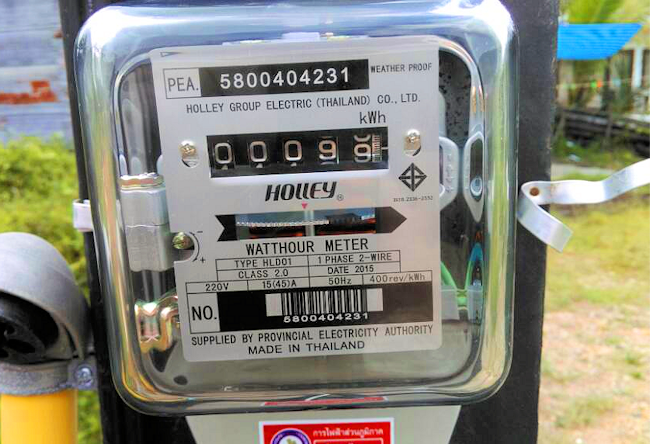

Many large houses in Thailand use single-phase power, including 5–6 bedroom homes. But whether it will work well for your house depends entirely on the total electrical load, especially air conditioning, water heaters, EV charging, pumps, and kitchen equipment.
In rural Thailand, most homes are supplied by the Provincial Electricity Authority (PEA), and standard residential service is usually:
- Single phase 230V
- Typical meter sizes:
- 15(45)A
- 30(100)A
- occasionally larger
A large modern 6 bed / 6 bath house can often still run on single phase if designed correctly.
When Single Phase Is Usually Fine
Single phase is normally OK if:
- Bedrooms use inverter air conditioners
- No central HVAC system
- No electric tank water heaters for every bathroom
- Cooking is mostly gas
- No EV fast charger
- No large workshop machinery
- Loads are staggered intelligently
Example typical loads:
| Item | Approx Power |
|---|---|
| 6 inverter AC units | 6–12 kW combined while running |
| Lighting | 0.5–1 kW |
| Refrigerator/freezers | 0.3–1 kW |
| Water pumps | 0.5–2 kW |
| TVs/computers | 0.5–1 kW |
| Microwave/kitchen | 1–3 kW |
| Instant shower heaters | 3.5–6 kW EACH |
The shower heaters are usually the biggest issue.
If 3–4 electric showers run simultaneously, single phase can struggle badly.
The Real Question: Maximum Simultaneous Load
The key is not house size.
It is:
“What could be running at the same time?”
A 6-bedroom house in Thailand could draw:
- 10–15 kW normally
- 20–30+ kW during peak use
That may exceed practical single-phase limits.
Typical Single Phase Limits in Thailand
Common practical upper limits:
| Service | Approx Practical Load |
|---|---|
| 15(45)A | ~10 kW |
| 30(100)A | ~20–23 kW |
| Very large single phase | ~30 kW max practical |
Beyond that, voltage drop and imbalance become problems.
When You SHOULD Use 3-Phase
You should strongly consider 3-phase if you have:
- Central ducted AC
- Multiple large condensers
- Pool pumps + large filtration
- Large kitchen
- EV charging
- Electric ovens
- Multiple electric water heaters
- 20 kW+ solar inverter system
- Workshop equipment
- Future expansion plans
For a luxury 6 bed / 6 bath house, many builders would recommend:
3-phase from the start
because upgrading later is expensive and annoying.
Advantages of 3-Phase in Thailand
Lower current per wire
Less voltage sag.
Better for many AC units
Especially if several compressors start simultaneously.
Better for solar
Large hybrid inverters often prefer or require 3-phase.
Easier future expansion
Very important in Thailand where people later add:
- EV chargers
- extra buildings
- restaurants
- rentals
- workshops
More stable voltage in rural areas
This matters a lot in Isaan.
Disadvantages of 3-Phase
Higher installation cost
Usually:
- larger panel
- more breakers
- more wiring complexity
Load balancing required
Circuits must be distributed properly.
Slightly higher monthly service fees
Usually not huge.
What I Would Recommend For Rural Isaan
Single phase is probably fine IF:
- inverter ACs only
- gas cooking
- no EV
- no central AC
- no simultaneous electric shower usage
- under ~15–18 kW peak load
Use 3-phase IF:
- luxury house
- heavy AC use
- future solar/battery system
- EV plans
- pool
- large kitchen
- guesthouse/rental expansion
- wanting “future proofing”
For many larger modern homes in Thailand today:
3-phase is increasingly becoming the smarter long-term choice.
Important Thailand-Specific Tip
In rural areas, transformer capacity matters more than people realize.
Even if PEA approves 3-phase:
- local transformer may be undersized
- voltage may still sag
- neighboring farms can affect power quality
Before building:
Ask PEA to Inspect Transformer Capacity
Especially if:
- you want solar
- large AC loads
- batteries
- EV charging
That can prevent major headaches later.
Based on those loads, you are getting into the upper range of what is comfortable for Thai residential single-phase service — but it still may be possible depending on your exact AC sizes and shower heater wattages.
Here’s a realistic estimate.
Estimated Running Load
4 Inverter AC Units
Typical Thai inverter wall units:
| Size | Running Power |
|---|---|
| 9,000–12,000 BTU | 600–1200 W |
| 18,000 BTU | 1200–1800 W |
Assuming medium-sized units:
- 4 ACs ≈ 4–6 kW total running
- startup surge is much lower with inverter systems
2 Shower Heaters
Thailand instant heaters are usually:
- 3,500W
- 4,500W
- 6,000W
Assume common 4,500W units:
- 2 × 4.5 kW = 9 kW
This is your biggest load by far.
Refrigerators
3 refrigerators:
- ~150–300W average each
- compressor cycling
Estimate:
- 600W total average
TVs
2 large 86″ TVs:
- modern LED ≈ 150–350W each
Estimate:
- 500W combined
LED Lighting
Whole house LED lighting:
- usually surprisingly low
Estimate:
- 300–600W
Ceiling Fans
2 fans:
- ~50–80W each
Estimate:
- 150W
Water Pump
500W pump:
- startup surge maybe 2–3× briefly
Estimate:
- 500W running
Estimated Total Simultaneous Load
| Load | Estimated |
|---|---|
| 4 inverter ACs | 5 kW |
| 2 shower heaters | 9 kW |
| refrigerators | 0.6 kW |
| TVs | 0.5 kW |
| lights | 0.5 kW |
| fans | 0.15 kW |
| pump | 0.5 kW |
Total: ≈ 16–17 kW running load
Now convert to current on Thai 230V single phase:
I=23017000≈74 A
That is roughly:
70–75 amps continuous
Can Single Phase Handle This?
YES — technically possible IF:
- you get a large 30(100)A meter from PEA
- wiring is properly sized
- high quality breaker panel
- balanced usage
- not all shower heaters + all ACs + kitchen loads peak simultaneously
A Thai 30(100)A meter can generally support:
- about 20–23 kW practical peak
So your estimated 16–17 kW is within range.
BUT…
You are already near the “luxury house” threshold where:
- voltage drop becomes noticeable
- lights dim
- AC efficiency drops
- breakers may nuisance-trip
- rural transformer weakness matters
Especially in rural Isaan.
My Recommendation For YOUR Situation
You CAN use single phase if:
- budget matters
- no EV charger
- no large electric oven
- no pool
- no future workshop
- no large solar system planned
and:
- use ONLY inverter ACs
- use smaller shower heaters
- avoid simultaneous heavy usage
However…
I would personally recommend 3-phase for this house.
Why?
Because your house is already:
- large
- AC-heavy
- multiple bathrooms
- likely future expansion
- likely future solar/battery system
3-phase gives:
- much lower wire current
- cooler wiring
- less voltage sag
- better AC performance
- easier future expansion
- better compatibility with large solar systems
Very Important Thailand-Specific Advice
If you stay single phase:
Use:
- VERY large main feeder cable
- quality grounding system
- Type 2 SPD surge protection
- oversized breaker panel
- separate circuits for every AC
- separate circuits for every shower heater
Do NOT let a rural Thai electrician undersize cables.
That is extremely common.
Final Recommendation
| Situation | Recommendation |
|---|---|
| Budget-focused | Large single phase OK |
| Long-term luxury home | 3-phase better |
| Future solar/battery/EV | Definitely 3-phase |
| Rural weak-grid area | 3-phase strongly preferred |
For your described load:
Single phase is POSSIBLE
but
3-phase is the smarter long-term design.
My Real-World Recommendation
For YOUR described house:
| Option | Recommendation |
|---|---|
| Single phase | 50 mm² copper feeder |
| 3-phase | 25 mm² copper usually sufficient |
| Long run (>50m) | increase size further |
| Future solar/EV | strongly consider 3-phase |
For your large 6 bed / 6 bath Thailand house with:
- 4 inverter ACs
- 2 shower heaters
- 3 refrigerators
- multiple TVs
- LED lighting
- water pump
- likely future expansion
here’s a realistic Thailand-oriented design approach.
1. Recommended Main Electrical Service
BEST LONG-TERM OPTION
3-Phase 230/400V
Recommended from:
Provincial Electricity Authority
Recommended Meter:
30/100A 3-phase
This gives:
- ample future expansion
- better AC performance
- better voltage stability
- easier solar integration
- easier EV charging later
If Staying Single Phase
Then:
30(100)A single phase minimum
Anything smaller is not appropriate for your load.
2. Main Breaker Recommendation
If Single Phase
Main breaker:
100A 2-pole
If 3-Phase
Main breaker:
63A–80A 4-pole
because load distributes across phases.
3. Consumer Unit (Breaker Panel)
Do NOT undersize this.
Thailand electricians often install tiny panels that become nightmares later.
Recommended:
36–48 circuit panel minimum
Even if not fully used initially.
Recommended Layout
| Circuit | Breaker |
|---|---|
| Each AC | Separate breaker |
| Each shower heater | Separate RCBO |
| Kitchen outlets | Separate |
| Refrigerator circuits | Separate |
| Lighting upstairs | Separate |
| Lighting downstairs | Separate |
| Outdoor circuits | Separate |
| Water pump | Separate |
| Spare circuits | At least 25% free |
Recommended Brands in Thailand
Good:
- Schneider Electric
- ABB
- Siemens
- Mitsubishi Electric
- Hager
Avoid ultra-cheap local clone breakers.
4. Recommended Breaker Sizes
Inverter ACs
| AC Size | Breaker |
|---|---|
| 9k–12k BTU | 15A |
| 18k–24k BTU | 20A |
Shower Heaters
| Heater Size | Breaker |
|---|---|
| 3500W | 20A |
| 4500W | 25A |
| 6000W | 32A |
IMPORTANT:
Shower heaters MUST use RCBO/RCD protection
Very important in Thailand.
5. Recommended Cable Sizes
AC Units
| AC Size | Cable |
|---|---|
| small inverter | 2.5 mm² copper |
| large inverter | 4 mm² copper |
Shower Heaters
| Heater | Cable |
|---|---|
| 3500W | 4 mm² |
| 4500W | 4–6 mm² |
| 6000W | 6 mm² |
Main Feeder
As discussed:
Single phase:
50 mm² copper recommended
3-phase:
25 mm² copper usually sufficient
6. Grounding System Design
This is CRITICAL in rural Thailand.
Recommended:
TN-S grounding system
with:
- dedicated earth conductor
- separate neutral and earth bars
Ground Rods
Recommended:
- minimum 2 copper-clad rods
- 2.4m length each
- spaced several meters apart
Use:
- 16 mm² grounding conductor minimum
Target Ground Resistance
Ideal:
under 5 ohms
Absolute maximum:
under 10 ohms
Thailand soil varies greatly.
7. Whole-House Surge Protection
VERY important in rural Isaan.
You absolutely should install:
Type 2 SPD
at the main panel.
Why:
- lightning
- unstable rural transformers
- voltage spikes
- inverter electronics
- TVs/appliances protection
Recommended brands:
- Schneider
- ABB
- Siemens
Also recommended:
SPD on solar inverter side later
8. Estimated Monthly Electric Bill
This depends enormously on AC usage.
Typical Usage Estimate
Heavy AC usage:
- 4 ACs running nightly
- shower heaters daily
- TVs/electronics
Estimated:
2500–5000 kWh/month
Estimated Thailand Cost (2026)
Approx:
฿11,000–฿25,000/month
depending on:
- thermostat settings
- insulation
- daytime usage
- AC efficiency
- occupancy
AC dominates the bill.
9. Solar System Recommendation
For YOUR house:
15–20 kW solar system ideal
especially in sunny Isaan.
Suggested System
| Component | Recommendation |
|---|---|
| Solar array | 15–20 kW |
| Inverter | 15 kW 3-phase hybrid |
| Battery | optional 20–40 kWh |
Expected Production in Isaan
Excellent solar region.
Approx:
60–90 kWh/day average
Could offset:
- most daytime usage
- substantial AC consumption
Recommended Solar Brands
Panels:
- LONGi
- JA Solar
- JinkoSolar
Inverters:
- Huawei
- Deye
- Sungrow
10. Realistic Best Overall Recommendation
For your exact scenario:
| Item | Best Choice |
|---|---|
| Utility service | 3-phase |
| Main panel | 48 circuit |
| Main feeder | 25 mm² copper |
| Grounding | dual rod TN-S |
| Surge protection | whole-house SPD |
| Solar ready | yes |
| Solar size | 15–20 kW |
| Future-proofing | excellent |
Your house is large enough that: